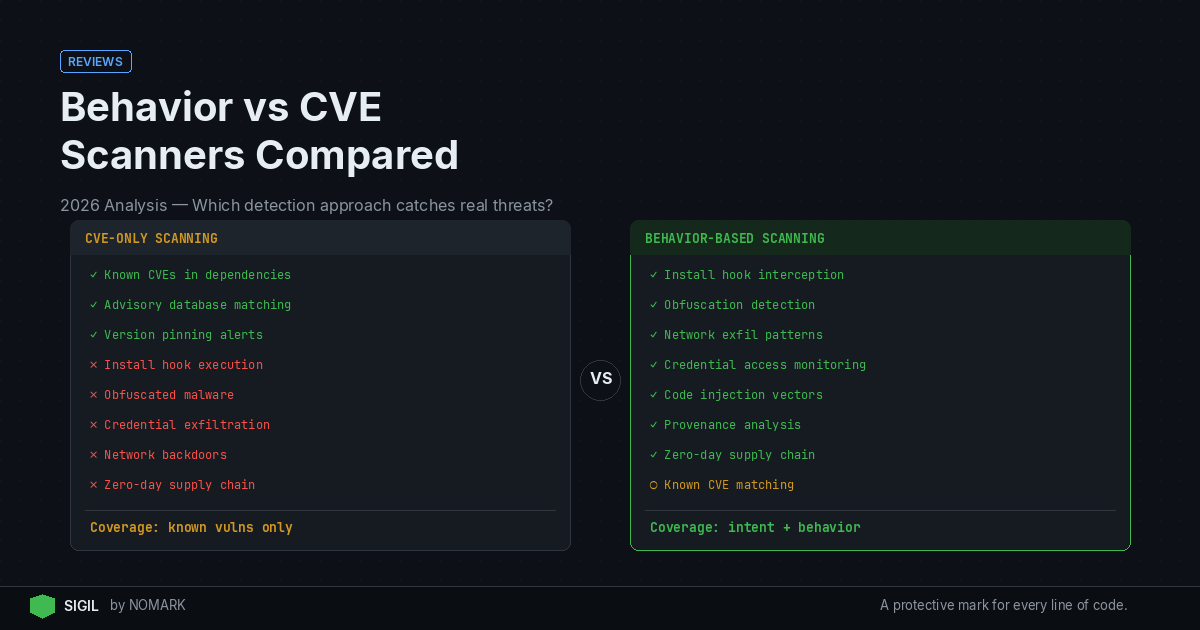
Behavior-based scanners analyze how code is likely to execute-detecting install hooks, obfuscation, data exfiltration, and suspicious network or file activity-while CVE-only scanners match dependencies against known vulnerability databases. In 2026, effective software and AI supply chain security combines both: CVE tools for patching known issues and behavior-based scanners to stop novel, malware-like threats before execution.
What is a CVE-only scanner and how does it work?
A CVE-only scanner, commonly known as a Software Composition Analysis (SCA) tool, works by inventorying your project's dependencies (libraries, packages, frameworks) and comparing them against databases of known vulnerabilities, primarily the Common Vulnerabilities and Exposures (CVE) list. These tools generate reports highlighting which dependencies contain publicly documented security flaws.
How CVE scanning operates:
-
Dependency Discovery: Identifies all third-party packages and libraries in your codebase.
-
Version Matching: Checks the exact versions against vulnerability databases like the National Vulnerability Database (NVD).
-
Risk Scoring: Assigns a severity score (often using CVSS) based on the CVE's published details.
-
Remediation Guidance: Suggests upgrading to a patched version or applying a workaround.
According to research on the limitations of modern vulnerability scanners, these tools are fundamentally reactive-they can only detect issues that have been publicly reported and assigned a CVE identifier. This creates a significant blind spot for novel attacks and malware that hasn't yet been cataloged in public databases.
What is a behavior-based scanner in application security?
A behavior-based scanner analyzes code for suspicious patterns and executable behavior before it runs on a system. Instead of checking version numbers against a list, it examines what the code is designed to do-looking for indicators of malicious intent like hidden install hooks, obfuscated payloads, network exfiltration attempts, or credential harvesting.
How behavior-based analysis works:
-
Static Behavior Analysis: Examines source code, package manifests, and build scripts for dangerous patterns (e.g.,
eval()of encoded strings, suspicious shell commands inpostinstallhooks). -
Dynamic/Runtime Simulation: Some advanced tools simulate execution in a sandbox to observe network calls, file system changes, and process spawning.
-
Provenance & Reputation Checks: Analyzes the origin of code, commit history, and author reputation for trust signals.
These scanners are proactive and designed to catch threats that lack a CVE, including zero-day attacks in the software supply chain. They are particularly valuable for securing AI tooling, where agents frequently pull and execute untrusted code from public repositories.
Behavior vs CVE Scanners: Side-by-Side Feature Comparison
The table below outlines the fundamental differences between these two security approaches, which are often complementary rather than directly competitive.
Behavior-Based Scanners vs CVE-Only Scanners: 2026 Comparison
Pros and Cons of CVE-Only Scanners
| Feature | Behavior-Based Scanners | CVE-Only Scanners |
|---|---|---|
| Primary Detection Method | Analyzes code patterns, execution hooks, and suspicious behavior | Matches dependency names/versions against known vulnerability databases |
| Threat Coverage | Novel malware, obfuscated payloads, data exfiltration, malicious install hooks, credential theft | Known vulnerabilities with published CVEs (e.g., CVE-2021-44228 Log4Shell) |
| Zero-Day Protection | High - detects malicious patterns regardless of public disclosure | None - relies on vulnerabilities being cataloged |
| False Positives | Moderate - requires tuning for legitimate but unusual code patterns | Low for version matching, but can flag unused or non-exploitable dependencies |
| Detection Speed | Very fast (seconds) for static analysis; slower for full sandboxing | Fast - primarily a database lookup |
| Ideal Use Case | Pre-execution quarantine, AI agent/package onboarding, CI/CD for behavior threats | Compliance, patch management, identifying known library vulnerabilities |
| Key Tools (Examples) | Sigil, Socket (npm-focused), Some SCA with behavior modules | Snyk, Dependabot, Trivy, OWASP Dependency-Check |
Pros:
-
Comprehensive for Known Issues: Excellent at identifying libraries with publicly documented CVEs, ensuring you patch critical, known flaws.
-
Clear Remediation: Typically provide straightforward upgrade paths or patches.
-
Mature Ecosystem: Well-integrated into developer workflows (GitHub, GitLab, IDEs) and CI/CD pipelines.
-
Standardized Scoring: Uses CVSS scores, making risk prioritization and reporting consistent.
Cons:
-
Blind to Novel Malware: Cannot detect a malicious package that doesn't have a published CVE. Research indicates over half of malicious packages contained no known CVEs at discovery.
-
Misses Behavioral Threats: Entirely misses threats based on malicious behavior in install scripts, obfuscated code, or data exfiltration.
-
Reactive by Nature: You are only protected after a vulnerability is discovered, reported, and added to a database.
-
No Code Analysis: Does not analyze what the code actually does, only what library it is.
Pros and Cons of Behavior-Based Scanners
Pros:
-
Proactive Against Zero-Days: Detects novel, unpublished attacks by analyzing malicious intent and patterns.
-
Catches Supply Chain Attacks: Specifically designed to find threats common in npm, PyPI, and AI agent ecosystems, like malicious
postinstallhooks. -
Pre-Execution Safety: Can quarantine or block risky code before it executes on a developer machine, preventing initial compromise.
-
Context-Aware: Understands code execution flow, not just library inventory.
Cons:
-
Potential for False Positives: Legitimate but unusual code (e.g., complex build scripts, obfuscation for IP protection) may trigger alerts.
-
Less Effective for Patching: Does not tell you if a library version has a known, patchable vulnerability.
-
Emerging Category: Fewer enterprise-grade tools compared to the mature CVE/SCA market, requiring careful evaluation.
-
Performance Trade-offs: Deep behavioral analysis (like sandboxing) can be slower than a database lookup.
Real-World Threats CVE Scanners Miss
Data indicates that traditional SCA tools can miss behavior-based threats that are rampant in modern ecosystems. Here are concrete examples:
-
Malicious Install Hooks: A benign-looking npm package can execute a malicious script defined in its
postinstallhook. This script runs automatically onnpm install, potentially stealing credentials or environment variables before any human review. CVE scanners see only the package version. -
Obfuscated Payloads: Code like
eval(atob('ZG93bmxvYWQ='))(which decodes todownload) is designed to hide its intent. A behavior scanner flags the use ofevalon a Base64-encoded string, while a CVE scanner sees nothing wrong. -
Data Exfiltration: A PyPI package that appears normal but contains code to send
.envfiles or SSH keys to an external server upon import. This is a behavioral network threat invisible to CVE checks. -
Provenance Attacks: A compromised or typosquatted package with a trustworthy name but malicious code from an untrusted source. Behavior analysis of the code itself is required to detect this.
When should you use behavior-based vs CVE-only scanners?
Choosing the right tool depends on your threat model, workflow, and the type of code you're securing. 2026 studies reveal growing adoption of pre-execution, behavior-focused scanners to complement legacy CVE-based approaches.
Choose a CVE-Only Scanner When:
-
Your primary compliance or security requirement is to patch known library vulnerabilities.
-
You work in a regulated environment that mandates tracking CVEs.
-
Your development team needs clear, actionable "upgrade to version X" guidance.
Choose a Behavior-Based Scanner When:
-
You are onboarding third-party code, AI agents, or MCP servers from untrusted sources.
-
Your workflow involves frequent
npm install,pip install, orgit cloneof unreviewed code. -
You need to prevent initial compromise from novel supply chain attacks, not just patch known holes.
-
You are securing an AI development pipeline where agents autonomously pull and execute code.
The Best Practice: Use Both. Modern security stacks layer these tools:
-
Behavior-Based First (Pre-Execution): Use a tool like Sigil to quarantine and audit new packages/agents before they enter your environment.
-
CVE Scanning (Ongoing): Use an SCA tool to continuously monitor your codebase for newly discovered vulnerabilities in already-approved dependencies.
How does Sigil fit into a modern AI supply chain security stack?
Sigil is an open-source, behavior-based scanner designed as a fast, local first line of defense. It operates as a pre-execution quarantine layer, specifically for the AI tooling ecosystem.
Sigil's role in the security stack:
-
Complements CVE Tools: It is not a replacement for Snyk or Dependabot. It runs before them, stopping threats those tools cannot see.
-
Focuses on AI/Agent Workflows: Intercepts commands like
git clone,npm install, and MCP server downloads to analyze the code before it touches the filesystem. -
Developer-First Design: Runs in under three seconds locally with zero telemetry, fitting into a developer's existing workflow without friction.
Key Capabilities for AI Security:
-
Six-Phase Behavioral Analysis: Scans for install hooks, dangerous code patterns, network exfiltration, credential access, obfuscation, and provenance.
-
Stops Malicious Execution: By quarantining code until a risk verdict is given, it prevents malicious
postinstallhooks from ever running. -
Integrates Everywhere: CLI for local use, with CI/CD (GitHub Actions, GitLab CI), IDE (VS Code, JetBrains), and Docker integrations for broader pipeline coverage.
For teams, Sigil offers Pro and Team tiers ($29/mo, $99/mo) adding cloud threat intelligence, dashboards, and audit logs, making it scalable from individual developers to enterprises.
What is the difference between behavior-based scanners and CVE-only scanners?
Behavior-based scanners analyze what code does-looking for malicious patterns like obfuscation, data exfiltration, or hidden install hooks. CVE-only scanners check what a code package is by comparing its name and version against databases of known vulnerabilities. The former catches novel, executable threats; the latter helps patch published library flaws.
When should I use a behavior-based scanner instead of a traditional CVE tool?
Use a behavior-based scanner when you need to evaluate untrusted code before it runs, such as when onboarding new AI agents, npm/PyPI packages, or MCP servers. Use a CVE tool for ongoing maintenance to patch known vulnerabilities in your existing, trusted dependencies. For comprehensive security, you should use both in tandem.
Can behavior-based and CVE-only scanners be used together?
Yes, and this is the recommended approach for 2026. Implement behavior-based scanning as a pre-execution gate (e.g., using Sigil on git clone or npm install) to block novel malware. Then, use CVE scanning in your CI/CD pipeline and dependency management to continuously patch known vulnerabilities in the code you've already approved.
What are examples of threats that CVE-only scanners usually miss?
CVE scanners miss: 1) Malicious postinstall/setup.py hooks that run on package installation, 2) Obfuscated payloads using eval() or base64.decode, 3) Code that exfiltrates environment variables or secrets to external servers, and 4) Typosquatted or compromised packages that perform malicious actions but have no published CVE.
How do behavior-based scanners help secure AI agents and packages?
AI agents often autonomously pull and execute code from repositories. A behavior-based scanner can intercept and audit this code in real-time, checking for the specific threats common in agent tooling-like hidden execution hooks, credential access, and obfuscated payloads-before the agent runs it, preventing initial compromise.
Key Takeaways
-
Behavior-based scanners detect executable threats (like install hooks & exfiltration), while CVE scanners only find known library vulnerabilities.
-
Research shows over half of malicious packages contain no known CVEs at discovery, creating a major blind spot for traditional tools.
-
The 2026 best practice is to use behavior-based scanning as a pre-execution gate and CVE scanning for ongoing patch management.
-
Tools like Sigil provide a fast, local behavior-based layer specifically designed for AI agent and software supply chain security.