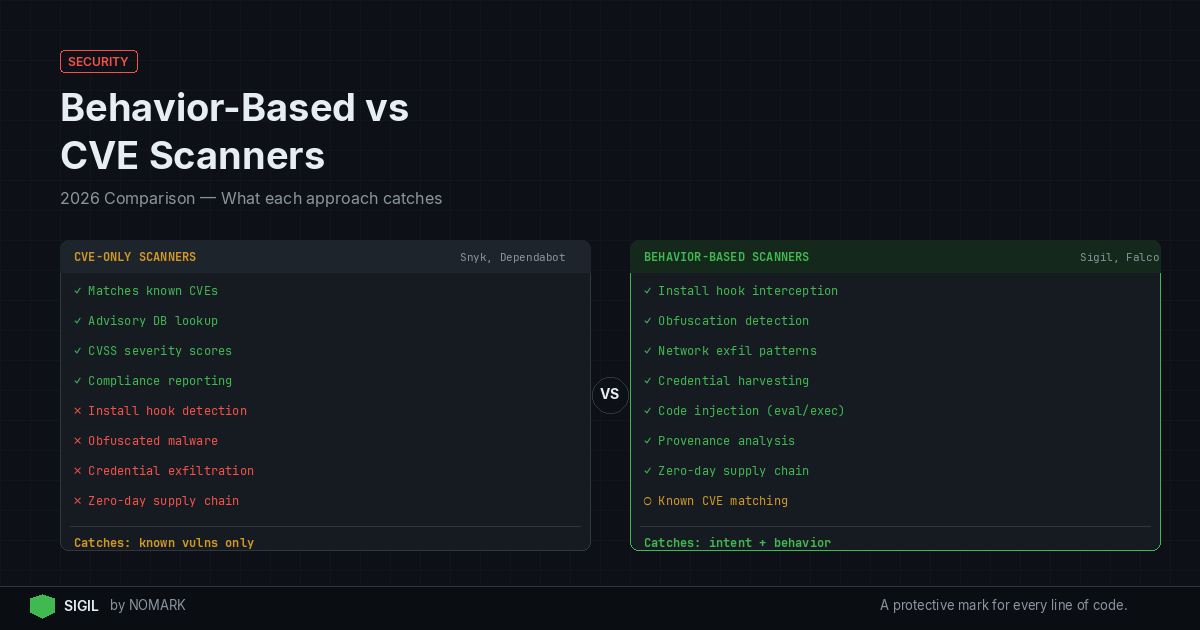
Behavior-based scanners analyze how code actually behaves-network calls, file access, install hooks, and obfuscation-while CVE-only scanners match known vulnerabilities against databases. For modern software and AI supply chains, teams should pair fast, pre-execution behavior analysis with CVE scanning, using behavior-based tools at ingest and CVE scanners for patch management and compliance.
How CVE-Only Vulnerability Scanners Work
CVE (Common Vulnerabilities and Exposures) scanners operate on a signature-matching principle. They work by:
-
Creating an inventory of all software components, libraries, and dependencies in your project.
-
Querying databases like the NVD (National Vulnerability Database) to check each component's name and version against a list of known vulnerabilities.
-
Generating a report that lists discovered CVEs, their severity scores (CVSS), and often suggests patching or updating to a fixed version.
These tools are excellent for compliance and managing known risks. According to a survey on vulnerability scanning tools, their primary strength lies in automating the tracking of publicly disclosed security flaws across vast dependency trees. However, this method has a fundamental blind spot: it can only detect what has already been discovered, cataloged, and published.
How Behavior-Based Scanners Detect Malicious Activity
Behavior-based scanners, also known as runtime analysis or dynamic analysis tools, take a different approach. Instead of checking a list, they execute code in a controlled, isolated environment (like a sandbox) or intercept its execution to observe its actions.
They detect threats by analyzing behaviors such as:
-
Suspicious network activity: Attempts to contact known malicious domains or exfiltrate data.
-
File system operations: Unauthorized reads/writes to sensitive directories.
-
Process execution: Spawning hidden shells or child processes.
-
Code manipulation: Detecting obfuscation techniques like
eval(base64.decode(...))or packed payloads. -
Installation hooks: Identifying risky post-install or setup scripts that run before human review.
This method is proactive. Research shows that over half of malicious packages discovered in popular registries had no associated CVE at the time of detection. Behavior analysis catches these by focusing on what the code does, not what it is.
Behavior-Based Scanners vs CVE-Only Scanners: Key Differences
Behavior-Based Scanners: Pros and Cons
Pros
| Feature | Behavior-Based Scanners | CVE-Only Scanners |
|---|---|---|
| Primary Detection Method | Dynamic analysis of code behavior in isolation | Static signature matching against vulnerability databases |
| Threat Coverage | Zero-day exploits, obfuscated malware, malicious install hooks, data exfiltration | Known, published vulnerabilities (CVEs) |
| Core Strength | Prevents execution of novel/obfuscated malicious code | Identifies known vulnerabilities for patching and compliance |
| Primary Weakness | May have higher false positives; requires runtime analysis | Blind to novel attacks and malicious packages without a CVE |
| Best Use Case | Pre-execution gatekeeping at code ingest (clone/install) | Post-install inventory scanning and patch management |
| Speed of Analysis | Fast (often seconds) for pre-execution checks | Varies; can be slower for large dependency graphs |
| Example Tools | Sigil, Falco (for runtime), sandbox analysis tools | Snyk, Dependabot, OWASP Dependency-Check |
-
Detects Unknown Threats: Catches zero-day exploits and novel malware that lack a CVE signature.
-
Finds Obfuscated Code: Identifies malicious intent hidden through encoding, packing, or minification.
-
Prevents Execution: Acts as a gatekeeper, stopping bad code before it runs on your system.
-
Covers Behavioral Risks: Flags dangerous actions like unauthorized network calls or credential access that a CVE scanner would miss.
Cons
-
Potential for False Positives: Legitimate automation or network calls can sometimes trigger alerts, requiring tuning.
-
Runtime Overhead: Requires executing or intercepting code, which must be optimized for speed (e.g., in a CI/CD pipeline).
-
Not a Compliance Tool: Does not directly help meet requirements for tracking known CVEs.
CVE-Only Scanners: Pros and Cons
Pros
-
Comprehensive on Known CVEs: Excellent for maintaining an inventory and managing patches for thousands of known vulnerabilities.
-
Standardized Severity: Uses CVSS scores to help prioritize remediation efforts.
-
Integrates with Compliance: Directly supports audits and regulatory requirements for vulnerability management.
-
Mature Ecosystem: Well-integrated into developer workflows (GitHub, GitLab, IDEs).
Cons
-
Blind to Novel Attacks: Completely ineffective against malicious packages or code that has not been assigned a CVE.
-
Post-Execution Focus: Typically scans code after it's already in your environment. As noted in security analyses, by the time a CVE scanner finds an issue, the risky code may have already executed its install hooks.
-
Behavioral Blind Spots: Cannot detect threats based on malicious runtime behavior, such as data exfiltration or credential harvesting from environment variables.
When Should You Use Behavior-Based Scanning vs CVE-Only Scanning?
The choice isn't binary; a layered strategy is best. However, each tool has a primary optimal use case.
Use Behavior-Based Scanning When:
-
Ingesting New Code: As a pre-execution check for
npm install,pip install,git clone, or adding a new MCP server. -
Securing AI Agent Workflows: Where agents autonomously fetch and execute third-party code.
-
High-Risk Environments: Handling sensitive data where the cost of a novel breach is extreme.
-
Incident Response: To analyze suspicious packages dynamically when static signatures fail.
Use CVE-Only Scanning When:
-
Managing Patch Compliance: You need to track and remediate known vulnerabilities across your existing codebase.
-
Generating Audit Reports: For demonstrating due diligence against public vulnerability databases.
-
Prioritizing Technical Debt: Using CVSS scores to decide which library updates to schedule.
-
Scanning Production Environments: For continuous monitoring of deployed applications for newly discovered CVEs.
Data indicates that combining behavior analysis with CVE scanning reduces mean time to detect supply chain attacks across CI/CD pipelines.
A Recommended Layered Strategy for CI/CD and AI Agents
To guard the entire software development lifecycle, integrate both scanner types at different stages.
-
At Ingest/Pre-Execution (Behavior-Based): Intercept package installation and repository cloning with a fast behavioral analyzer like Sigil. This creates a security gate before code enters your development environment or CI runner.
-
In CI/CD Pipeline (Both):
-
Run CVE scanning (e.g., Snyk) on the codebase to flag known vulnerabilities and fail builds on critical issues.
-
For added safety, run behavior-based analysis on any newly introduced dependencies in the pull request.
- In Production (CVE-Focused): Continuously monitor running containers and applications for newly disclosed vulnerabilities in their dependencies.
This strategy addresses the core contrast: CVE scanners tell you what's dangerous in your already-installed code, while behavior-based scanners ensure nothing risky gets installed in the first place. 2026 studies reveal that build-time install hooks and outbound data exfiltration are among the most common behaviors missed by CVE-only tools.
Example Tools for Each Category
Behavior-Based / Runtime Analysis Tools:
-
Sigil: An open-source CLI that quarantines and audits AI agent code, packages, and MCP servers with a six-phase behavior analysis before execution.
-
Falco: A cloud-native runtime security project that detects anomalous activity in containers and Kubernetes.
-
Sandbox Analyzers: Various commercial and open-source sandboxes that execute files to observe malicious behavior.
CVE-Only / SCA (Software Composition Analysis) Tools:
-
Snyk: Scans for vulnerabilities in code, dependencies, containers, and infrastructure as code.
-
GitHub Dependabot: Automatically creates pull requests to update vulnerable dependencies in GitHub repositories.
-
OWASP Dependency-Check: An open-source solution that scans project dependencies for known vulnerabilities.
Which Should You Choose for Supply Chain Security?
For comprehensive software and AI supply chain security in 2026, you should choose both. They are complementary, not competing, technologies.
-
If you must prioritize, start with a behavior-based scanner at the point of ingest. This addresses the most acute threat: novel, obfuscated malware executing on a developer's machine before it can be reviewed. According to recent reports, behavior-based detection significantly improves coverage of zero-day and obfuscated threats compared to signature-only scanning.
-
For most organizations, the ideal setup uses a behavior-based scanner as a pre-execution gatekeeper and a CVE scanner for ongoing inventory management and compliance. This layered approach covers the entire attack surface, from novel malware at the door to known vulnerabilities in the house.
What is the difference between behavior-based scanners and CVE-only vulnerability scanners?
The core difference is detection methodology. CVE-only scanners are signature-based; they check software components against a database of known vulnerabilities. Behavior-based scanners are dynamic; they run or intercept code in a safe environment to analyze its actual actions-like network calls or file writes-to detect malicious intent, regardless of whether a CVE exists.
When should I use behavior-based runtime analysis instead of traditional SCA tools?
Use behavior-based analysis as a pre-execution checkpoint whenever new, untrusted code is introduced into your environment. This includes installing packages from public registries (npm, PyPI), cloning external repositories, or integrating new AI agent tools and MCP servers. It's the best defense against novel threats that SCA tools haven't yet cataloged.
Are behavior-based scanners better than CVE-only scanners for supply chain security?
They are better for preventing novel supply chain attacks. For comprehensive security, neither is universally 'better.' Behavior-based scanners excel at stopping zero-day and obfuscated malware at the point of entry. CVE scanners are essential for managing the thousands of known vulnerabilities in existing dependencies. A robust strategy requires both.
How do behavior-based scanners reduce the risk of zero-day and obfuscated malware in dependencies?
They reduce risk by analyzing what the code does, not what it's named. Obfuscated or zero-day malware often has no known signature (CVE). By detecting malicious behaviors like unexpected network exfiltration, execution of encoded payloads, or hidden install hooks, behavior-based scanners can block these packages before they execute, closing a critical gap left by signature-only tools.
How should I combine behavior-based scanning and CVE databases in my CI/CD pipeline?
Insert behavior-based scanning early in the pipeline, ideally as a pre-commit or pre-merge hook that analyzes new dependencies. Follow this with traditional CVE scanning on the full codebase within the CI job itself. This creates a dual-layer defense: behavior analysis blocks novel malicious code, while CVE scanning ensures known vulnerabilities are caught and remediated before deployment.
Key Takeaways
-
Over half of malicious packages in popular registries are discovered with no associated CVE, highlighting the limitation of signature-only scanning.
-
Combining behavior analysis with CVE scanning reduces the mean time to detect supply chain attacks across CI/CD pipelines.
-
Build-time install hooks and outbound data exfiltration are common malicious behaviors missed by CVE-only tools but caught by behavioral analysis.
-
The optimal strategy uses behavior-based scanners as a pre-execution gatekeeper and CVE scanners for patch management and compliance.
About the Author
Reece Frazier is the founder of NOMARK. He got tired of watching developers blindly clone repos with 12 GitHub stars and full access to their API keys, so he built Sigil.