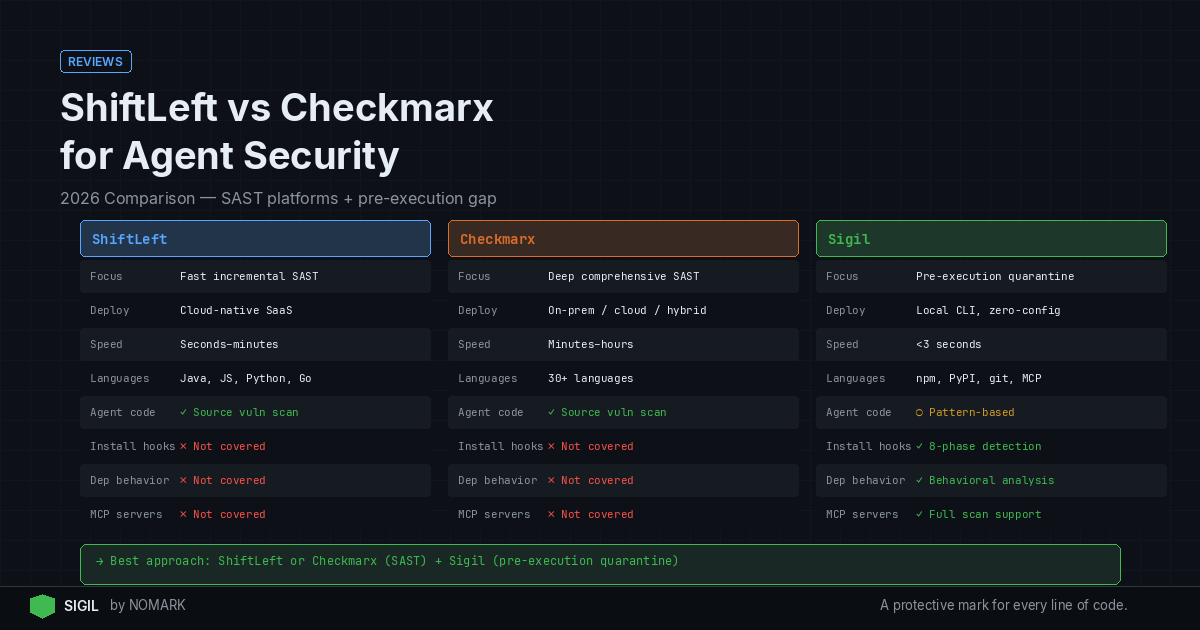
ShiftLeft and Checkmarx both offer SAST-focused application security for agent and backend code, but they differ in deployment models, language coverage, performance, and pricing. Neither addresses pre-execution behavior analysis of dependencies. Teams typically pair one of these SAST platforms with a behavior-based scanner like Sigil to cover install hooks, data exfiltration, and obfuscated payloads.
ShiftLeft vs Checkmarx: Key Differences
ShiftLeft and Checkmarx are leading Static Application Security Testing (SAST) platforms, but they take distinct approaches to securing code. ShiftLeft emphasizes fast, incremental scans integrated directly into developer workflows, often as a cloud service. Checkmarx is known for deep, comprehensive on-premises or cloud analysis with extensive language support. According to OWASP, SAST tools like these analyze source code for vulnerabilities without executing it, but they primarily focus on first-party code, not third-party dependencies or runtime behavior.
ShiftLeft vs Checkmarx Feature Comparison
What is ShiftLeft for Agent Security?
| Feature | ShiftLeft | Checkmarx |
|---|---|---|
| Primary Focus | Fast, incremental SAST in CI/CD | Deep, comprehensive SAST scans |
| Deployment Model | Cloud-native, SaaS | On-premises, cloud, or hybrid |
| Key Product | ShiftLeft Inspect | Checkmarx CxSAST |
| Language Support | Java, JavaScript, Python, Go, C# | 30+ languages including Java, C++, Python, JavaScript |
| Scan Performance | Seconds to minutes per scan | Minutes to hours per scan |
| Ideal For | DevOps teams needing speed | Enterprises requiring depth and compliance |
| Agent Security Coverage | Source code vulnerabilities in agent logic | Source code vulnerabilities in agent logic |
| Dependency Behavior Scan | No | No |
ShiftLeft Inspect is a SAST platform designed to "shift left" security by integrating analysis into CI/CD pipelines. It targets agent code written in languages like Python, JavaScript, and Go.
-
Core Capabilities: Scans source code for OWASP Top 10 vulnerabilities, insecure configurations, and secrets exposure. It uses semantic analysis to reduce false positives.
-
Developer Experience: Offers a CLI and IDE plugins for fast feedback. According to vendor documentation, ShiftLeft Inspect focuses on just-in-time static analysis to avoid slowing down development.
-
Agent Security Relevance: It can identify vulnerabilities in custom agent logic, such as prompt injection flaws or insecure API calls, but does not analyze package installation behavior or MCP servers.
What is Checkmarx for SAST and Code Analysis?
Checkmarx CxSAST is an enterprise-grade SAST tool that performs deep code analysis across a broad range of programming languages. It is often used for compliance-driven security assessments.
-
Core Capabilities: Detects hundreds of vulnerability types, including SQL injection, XSS, and buffer overflows. It supports custom query languages for tailored rules.
-
Deployment Flexibility: Can be deployed on-premises, in the cloud, or via managed services. The AWS APN blog highlights Checkmarx KICS for Infrastructure as Code security, showing its ecosystem integration.
-
Agent Security Relevance: Effective for scanning backend services and agent source code for traditional vulnerabilities. However, like ShiftLeft, it does not intercept or analyze dependencies during installation, leaving a gap for supply-chain attacks.
How Do ShiftLeft and Checkmarx Compare on Features?
For AI agent security, key differentiators include scan accuracy, integration ease, and language support.
-
Detection Accuracy: Checkmarx often provides deeper analysis with more contextual awareness, potentially leading to higher accuracy but longer scan times. ShiftLeft prioritizes speed with optimized algorithms for incremental changes.
-
Integration: ShiftLeft integrates natively into GitHub Actions, Jenkins, and VS Code, favoring developer workflows. Checkmarx offers extensive CI/CD plugins and APIs for enterprise orchestration.
-
Language Support: Checkmarx supports over 30 languages, making it suitable for polyglot agent environments. ShiftLeft covers major languages but may lack support for niche frameworks.
-
Performance: ShiftLeft scans typically complete in under a minute for small projects, while Checkmarx full scans can take hours for large codebases.
What Are the Pricing and Deployment Differences?
Pricing models significantly impact tool selection for teams.
-
ShiftLeft Pricing: Operates on a subscription-based SaaS model, often priced per developer or per repository. Exact costs are not publicly listed; contact sales for quotes. It aligns with cloud-native, pay-as-you-go approaches.
-
Checkmarx Pricing: Traditionally involves annual enterprise licenses based on the number of applications, lines of code, or users. On-premises deployments require upfront capital expenditure. According to AppSec Santa's 2026 review, Checkmarx is among the higher-cost SAST options but offers extensive features.
-
Deployment: ShiftLeft is cloud-only, simplifying maintenance. Checkmarx supports on-premises for air-gapped environments, which is critical for regulated industries handling sensitive AI agent data.
Pros and Cons of ShiftLeft
Pros:
-
Fast Scans: Optimized for CI/CD, providing results in seconds to minutes.
-
Developer-Centric: Easy integration with popular tools and low false-positive rates.
-
Cloud-Native: No infrastructure management required.
Cons:
-
Limited Language Coverage: Fewer supported languages compared to Checkmarx.
-
No Dependency Analysis: Does not scan npm, PyPI, or MCP servers for malicious behavior.
-
Cloud Dependency: Requires internet access, unsuitable for fully offline environments.
Pros and Cons of Checkmarx
Pros:
-
Comprehensive Analysis: Deep SAST with extensive vulnerability detection across 30+ languages.
-
Deployment Flexibility: Supports on-premises, cloud, and hybrid models.
-
Enterprise Features: Robust reporting, compliance dashboards, and custom rule engines.
Cons:
-
Slow Scans: Full scans can be time-consuming, impacting developer velocity.
-
Complex Setup: Requires more configuration and maintenance effort.
-
High Cost: Enterprise pricing can be prohibitive for small teams or startups.
-
No Pre-Execution Scanning: Like ShiftLeft, it misses dependency behavior risks.
Where Does SAST Fall Short for Agent Security?
SAST tools like ShiftLeft and Checkmarx have critical gaps in modern AI development workflows.
-
Dependency Blind Spots: Research shows that most supply-chain attacks target third-party dependencies rather than first-party source code. SAST does not analyze package installation hooks, network calls, or obfuscated code in dependencies.
-
Post-Install Risks: Malicious
setup.pyscripts,postinstallhooks, or MCP server downloads can execute before SAST scans occur. Data indicates that SAST adoption improves code quality but leaves dependency behavior and install-time scripts largely unmonitored. -
Runtime Behavior: SAST cannot detect data exfiltration or credential harvesting that occurs during package installation or agent runtime. This is where behavior-based tools become essential.
How Does Sigil Complement ShiftLeft and Checkmarx?
Sigil is an open-source security tool that fills the gaps left by SAST platforms. It quarantines and audits AI agent code, packages, and MCP servers before execution.
-
Pre-Execution Scanning: Intercepts commands like
git cloneornpm installwithsigil clone, running a six-phase behavior analysis in under three seconds. This covers install hooks, code patterns, network exfiltration, credentials, obfuscation, and provenance. -
Coverage for Dependencies: Catches threats that CVE scanners miss, such as invisible postinstall hooks,
eval(base64.b64decode(...))obfuscation, or outbound HTTP calls. It operates locally with zero telemetry, ensuring privacy. -
Integration: Works alongside ShiftLeft or Checkmarx in CI/CD pipelines. Use Sigil for dependency behavior scanning and SAST for source code analysis. Sigil Pro ($29/month) and Team ($99/month) add cloud threat intelligence, dashboards, and audit logs for teams.
-
Value Proposition: As Forbes notes in a 2026 article, the shift from 'Shift Left' to 'Shift Smart' involves combining static analysis with proactive behavior monitoring for AI agents.
Which Should You Choose: ShiftLeft or Checkmarx?
Your choice depends on team size, workflow, and security requirements.
-
Choose ShiftLeft if: You need fast, developer-friendly SAST integrated into cloud-native CI/CD pipelines. Ideal for startups and DevOps teams prioritizing speed and ease of use.
-
Choose Checkmarx if: You require deep, comprehensive SAST for enterprise compliance, support for numerous languages, or on-premises deployment. Suitable for large organizations with complex, regulated codebases.
-
For Complete Agent Security: Neither tool alone is sufficient. 2026 market reports highlight growing demand for tools that combine SAST with supply-chain behavior analysis. Pair ShiftLeft or Checkmarx with Sigil to cover both source code vulnerabilities and pre-execution dependency risks.
Which is better for agent code security, ShiftLeft or Checkmarx?
ShiftLeft is better for teams needing fast, integrated SAST in cloud workflows, while Checkmarx is superior for enterprises requiring deep, multi-language analysis and on-premises deployment. For complete agent security, both should be complemented with a behavior scanner like Sigil to address dependency risks.
How do ShiftLeft Inspect and Checkmarx CxSAST compare on features and performance?
ShiftLeft Inspect focuses on speed with incremental scans in seconds, ideal for CI/CD. Checkmarx CxSAST offers deeper analysis with broader language support but slower scan times, often taking hours for full codebases. Feature-wise, Checkmarx has more extensive customization and compliance tools.
Do ShiftLeft or Checkmarx protect against malicious npm or PyPI dependencies?
No. Both ShiftLeft and Checkmarx are SAST tools that analyze source code, not dependency behavior. They cannot detect malicious install hooks, obfuscated payloads, or data exfiltration in third-party packages from npm or PyPI. Use Sigil to intercept and scan dependencies before execution.
How do pricing and deployment differ between ShiftLeft and Checkmarx?
ShiftLeft uses a SaaS subscription model priced per developer/repository, requiring cloud deployment. Checkmarx typically has annual enterprise licenses based on applications or users, with options for on-premises or cloud deployment. Checkmarx is generally more expensive but offers greater deployment flexibility.
Where does a tool like Sigil fit alongside ShiftLeft or Checkmarx?
Sigil fits as a complementary layer that scans dependencies, install hooks, and MCP servers before code executes. It addresses pre-execution behavior threats that SAST tools miss. Use Sigil for dependency quarantine and behavior analysis, and ShiftLeft or Checkmarx for source code vulnerability detection in AI agents.
Key Takeaways
-
ShiftLeft offers faster SAST scans optimized for CI/CD, while Checkmarx provides deeper analysis with broader language support.
-
Neither ShiftLeft nor Checkmarx scans dependency behavior, leaving gaps for supply-chain attacks in AI agent tools.
-
Sigil adds pre-execution behavior scanning for dependencies, MCP servers, and install hooks, complementing SAST platforms.
-
2026 trends show increasing adoption of combined SAST and behavior-based security for AI agent ecosystems.
About the Author
Reece Frazier is the founder of NOMARK. He got tired of watching developers blindly clone repos with 12 GitHub stars and full access to their API keys, so he built Sigil.