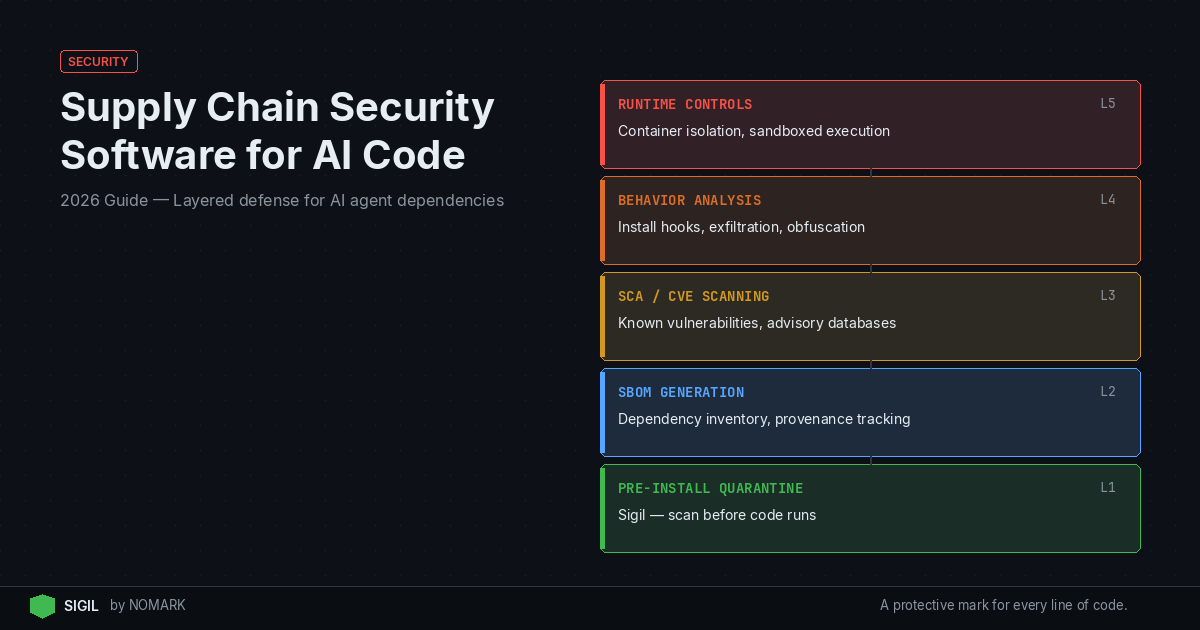
Software supply chain security software in 2026 spans four layers: SBOM and provenance tools, SCA and CVE scanners, behavior-based pre-execution scanners like Sigil, and runtime/data exfiltration controls. For AI agents and OSS-heavy workflows, you typically need a stack that inventories components, finds known vulns, detects malicious behavior pre-install, and enforces least-privilege at runtime.
What is software supply chain security software?
Software supply chain security software refers to tools and platforms designed to protect the integrity of the code, dependencies, and artifacts you integrate into your applications. It addresses risks introduced by third-party open-source libraries, packages, containers, and AI model artifacts.
Why does it matter in 2026? Modern development, especially with AI agents, involves pulling in hundreds or thousands of external components. Each one is a potential attack vector. According to the 2026 State of the Software Supply Chain Report, AI and automation-heavy teams pull in substantially more third-party packages and tools, amplifying supply chain risk. A breach through a single dependency can lead to data exfiltration, credential theft, or system compromise.
Core categories of supply chain security tools
A modern security stack is layered. These four categories work together:
-
SBOM & Provenance Tools: Generate a Software Bill of Materials (SBOM) to inventory components and verify their origin (provenance). Examples: SPDX tools, in-toto, SLSA frameworks.
-
SCA & CVE Scanners: Software Composition Analysis (SCA) tools scan for known vulnerabilities (CVEs) in open-source dependencies. Examples: Snyk, Dependabot, JFrog Xray, WhiteSource.
-
Behavior-Based Pre-Execution Scanners: These tools analyze code behavior-like install hooks, network calls, and obfuscation-before it runs on your system. They catch malicious logic that CVE scanners miss. Sigil is a leading example in this category.
-
Runtime & Data Exfiltration Controls: Enforce policies and monitor for suspicious activity after code is deployed or executed. Examples: container security platforms (Aqua), CSPM tools, egress filtering.
Securing AI agents and autonomous workflows
AI agents, MCP servers, and AI-powered development tools (like AutoGPT or LangChain) introduce unique supply chain challenges. They dynamically pull in code, plugins, and model artifacts, often with elevated permissions. Traditional SCA tools are blind to the novel threats in this ecosystem.
Key AI-specific risks include:
-
Malicious Install Hooks: Code that executes automatically during
pip installornpm installbefore you can review it. -
Obfuscated Payloads: Dependencies using
base64encoding oreval()statements to hide malicious intent. -
Credential Harvesting: Scripts designed to steal API keys or environment variables from your development environment.
-
Model Provenance Issues: Downloading AI models from untrusted or tampered repositories.
According to recent software supply chain reports, the majority of breached organizations were already using at least one SCA or CVE scanner, highlighting gaps in behavior-focused detection. For AI workflows, you need tools that understand these behavior-based attack patterns.
SCA vs. Behavior-Based Scanning for AI Code
Do I still need Snyk if I use a behavior-based tool?
| Feature | SCA/CVE Scanners (Snyk, Dependabot) | Behavior-Based Scanners (Sigil) |
|---|---|---|
| Primary Focus | Known vulnerabilities (CVEs) in dependencies | Malicious behavior & code patterns pre-execution |
| Detection Method | Database matching of package versions | Static & dynamic analysis of package behavior (hooks, network, obfuscation) |
| Best For | Patching known, published vulnerabilities | Stopping zero-day, obfuscated, or logic-based attacks |
| AI Agent Relevance | Limited; misses agent-specific runtime risks | High; analyzes install hooks, plugin code, and MCP server behavior |
| Speed | Varies (can be slow for deep scans) | Fast (under 3 seconds for local analysis) |
| Operation | Often cloud-based, requires database updates | Can run fully offline, locally |
Yes. Behavior-based scanners like Sigil are a complement, not a replacement, for SCA tools like Snyk or Dependabot. Think of it as a layered defense:
-
Snyk/Dependabot answers: "Does this package contain any known, published vulnerabilities?"
-
Sigil answers: "Will this package do something malicious when it installs or runs, regardless of its CVE status?"
You need both. A package can have no known CVEs but still contain a credential-stealing script. Conversely, a package might have a known CVE but its intended behavior is benign. 2026 studies reveal that combining SBOM, SCA, and behavior-based scanning reduces supply chain incident risk far more than relying on any single control.
Pros and Cons of SCA Tools
Pros:
-
Comprehensive CVE Database: Excellent at identifying known vulnerabilities with high accuracy.
-
Remediation Guidance: Often provide fix suggestions, upgrade paths, and PR automation.
-
Wide Ecosystem Support: Integrated into CI/CD, IDEs, and major repositories.
Cons:
-
Blind to Novel Threats: Cannot detect malicious logic, obfuscation, or zero-day supply chain attacks.
-
Alert Fatigue: Can generate many low-severity alerts for development-heavy teams.
-
Cloud Dependency: Many require an external service, which is a problem for air-gapped environments.
Pros and Cons of Behavior-Based Scanners
Pros:
-
Catches Unknown Malice: Detects attacks based on behavior, not just known signatures.
-
Pre-Execution Safety: Blocks threats before they run on your machine ("left of boom").
-
Developer Experience: Fast, local scans fit into existing CLI workflows without context switching.
-
Privacy & Offline Operation: Tools like Sigil can run fully offline with no telemetry.
Cons:
-
Not a CVE Scanner: Does not replace the need for patching known vulnerabilities.
-
Newer Category: Less established in some enterprise procurement processes compared to SCA.
Designing a layered supply chain security stack for 2026
A robust strategy for AI and modern development integrates tools across the software lifecycle.
1. Inventory & Provenance: Start with SBOM generation to know what you're using. Enforce SLSA levels or signed provenance for critical components.
2. Vulnerability Scanning (SCA): Integrate SCA scanning into your PRs and CI/CD pipeline to catch known CVEs early. Automate pull requests for fixes.
3. Pre-Execution Behavior Scan: Insert a behavior-based scan before code executes locally or in your build environment. This is crucial for AI agents pulling dynamic dependencies. Use CLI aliases (e.g., sigil clone instead of git clone) or CI plugins to intercept and analyze packages.
4. Runtime Guardrails: Harden your runtime environment. Use least-privilege principles, network policies to block unexpected egress traffic, and runtime security for containers. Data indicates that pre-execution controls can block whole classes of attacks, such as malicious install hooks and credential-stealing scripts, before they ever run, reducing the burden on runtime controls.
How Sigil fits alongside your existing SCA and SBOM tools
Sigil is designed as the behavior-based detection layer in your stack. It operates at the critical moment after a package is fetched but before its code is allowed to execute.
Sigil's role in a complete stack:
-
SBOM/SCA First: Your pipeline uses SBOM tools and Snyk to inventory and check for CVEs.
-
Sigil as the Gatekeeper: Before
npm installorpip installruns hooks, Sigil intercepts the package. It performs a fast, six-phase analysis (checking for install hooks, code patterns, network exfiltration, credential access, obfuscation, and provenance). -
Informed Decision: You get a clear risk score and verdict in under three seconds. You can block high-risk packages or audit them further.
-
Runtime as Backup: Any code that passes through these gates then runs in a runtime environment with appropriate controls.
This approach is particularly valuable for AI agent developers, security engineers auditing MCP servers, and DevOps teams managing internal package repositories, filling the critical detection gap that SCA tools leave open.
Best supply chain security tools for AI agent code
When selecting tools for AI agent security, prioritize those that understand dynamic, behavior-based threats.
For Behavior-Based Pre-Execution Scanning:
- Sigil: Open-source, fast CLI focused on AI agent packages, MCP servers, and OSS dependencies. Its parallel analysis engine is built for the speed developers need.
For SCA & CVE Management:
-
Snyk: Leader in developer-friendly SCA with strong IDE and CI integrations.
-
Dependabot: Native GitHub integration and automated PRs for vulnerability fixes.
-
JFrog Xray: Deep integration with Artifactory for unified binary management and scanning.
For SBOM & Provenance:
-
CycloneDX/Syft: Leading tools for generating standard SBOMs.
-
SLSA Frameworks: For building provenance into your supply chain.
For Runtime/Data Exfiltration Control:
-
Aqua Security/Capsule8: Specialized in container and runtime security.
-
Network Policy Engines: Like Cilium or cloud-native firewalls to limit egress traffic.
The best stack combines one from each category, tailored to your team's primary language and deployment environment.
What is software supply chain security software and why does it matter in 2026?
Software supply chain security software is a category of tools that protect the code, libraries, and artifacts you import into your projects. It matters in 2024 because attacks increasingly target these third-party dependencies, and AI-driven development pulls in more of them than ever, creating a larger attack surface that traditional security tools miss.
Which tools are best for securing AI agent code and model dependencies?
Securing AI agent code requires a layered approach. Use an SCA tool (like Snyk) for known CVEs, a behavior-based scanner (like Sigil) to detect malicious logic in install hooks and plugins, an SBOM tool for inventory, and runtime controls to limit network access. Sigil is particularly designed for the pre-execution analysis of AI agent packages and MCP servers.
How do behavior-based scanners differ from SCA and CVE scanners?
SCA/CVE scanners check a package against a database of known vulnerabilities. Behavior-based scanners analyze what the package actually does-its network calls, file system access, install scripts, and use of obfuscation-to identify malicious intent regardless of whether a CVE exists. They catch different, often more novel, classes of attacks.
How can I prevent data exfiltration and credential theft from dependencies?
Prevent data exfiltration with a three-layer strategy: 1) Use a behavior-based scanner (like Sigil) to block packages with hidden network calls pre-install. 2) Enforce least-privilege principles in your runtime environment. 3) Implement strict network egress controls and policies to block unauthorized outbound traffic from your applications and build systems.
What are the best alternatives to Snyk for supply chain security?
Strong alternatives to Snyk include Dependabot (for GitHub-native teams), JFrog Xray (for organizations using Artifactory), and WhiteSource (now Mend). However, these are all SCA tools. For a complete strategy, you should also evaluate behavior-based alternatives like Sigil, which solves a different problem and complements rather than replaces SCA.
Key Takeaways
-
In 2026, a complete supply chain security stack requires four layers: SBOM, SCA, behavior-based scanning, and runtime controls.
-
Research shows AI teams pull in significantly more third-party code, making layered defense critical.
-
Behavior-based scanners like Sigil detect malicious logic and zero-day attacks that CVE databases miss.
-
Combining SCA with behavior-based scanning reduces incident risk more than any single control.
About the Author
Reece Frazier is the founder of NOMARK. He got tired of watching developers blindly clone repos with 12 GitHub stars and full access to their API keys, so he built Sigil.